oleena mak
Referrals + Retention in Crypto
Can growth happen without FOMO, airdrops or incentives?
A few different research articles and reports caught my attention this week. SixDegree Lab provided a look into the effectiveness of protocol airdrop campaigns on wallet acquisition and retention. Let’s take a look.
When observing the retention of unique wallet addresses that received an airdrop, the average churn rate is 80% after four months.

There are still a lot of unanswered questions, like what other activities these wallet addresses may have conducted in the same period of time. However, we can at least observe that users are, to no surprise, not holding onto their airdrop tokens
What’s more interesting is the cost of these airdrop campaigns. Based on the number of retained users at month four, the average CAC ranges from $1,000 to $10,000. Yes, that’s a big range, but for comparison, tradfi has an average CAC of $50 to $1500.
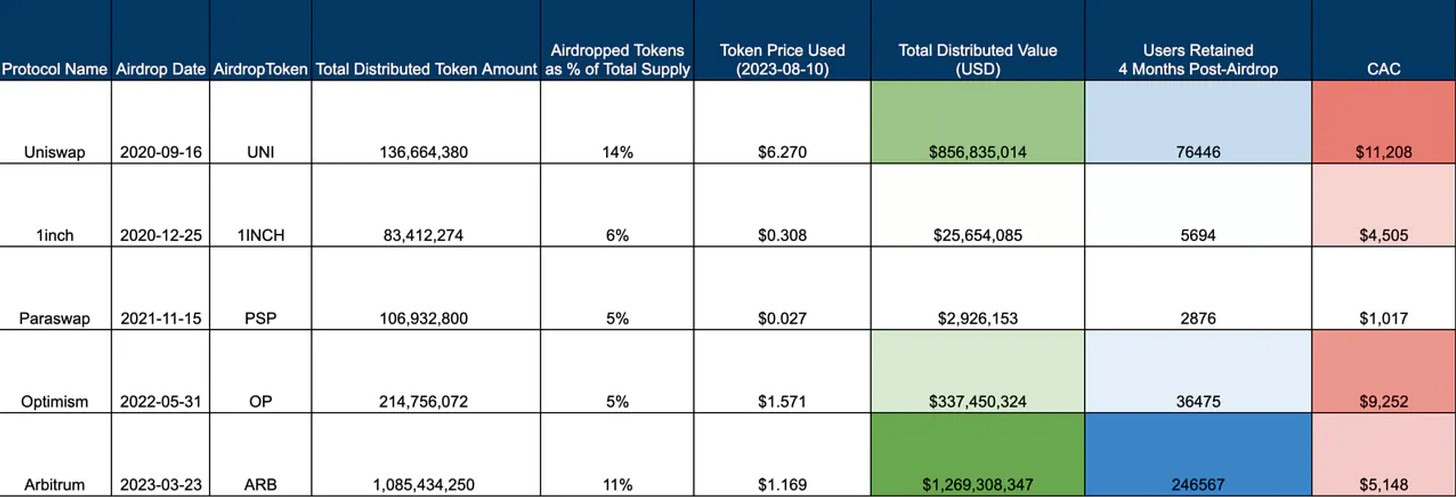
Airdropping tokens has become a primitive tactic to inject liquidity into protocols and keep users from moving to other chains. But more and more we are seeing just how ineffective this strategy is to grow projects sustainably and retain users.
Aside from airdrops, high-yield rates, time/price pressure and promotions are also a form of FOMO marketing to push users to take action. After working on countless rewards and FOMO campaigns at a crypto company in the past year, I can tell you that the desperate attempt to give rewards does little to bring users back to the platform in a meaningful way.
This is even more true for DeFi protocols where users are inherently mercenary and driven by profit-optimization. You can nudge users to take certain actions through onchain notifications or incentives, but you can’t change their very nature and intrinsic motivations.
So this begs the question: is there a way to recapture DeFi users’ attention without having to rely heavily on unsavory marketing tactics and incentives like airdrops?
I think that rather than trying to get power-DeFi users to change their motivations, perhaps we should focus on optimizing the dollar value amount in referrals they could bring to the platform. But for this to work effectively, these two things must be true:
The product is good and provides a delightful user experience, and
Users can form a strong psychological attachment to the product.
Genuine referrals are priceless
If you also work within the blockchain space, you’ve probably experienced this before. You introduce yourself to someone, talk about what you do and be reminded about just how early you are in the industry. For newcomers, the common questions will be “how does crypto work” and “how do I buy my first crypto?” This is where the referral magic happens.
Chances are, you’ll recommend them the most easy-to-use platform. Perhaps, it’s the same platform you used when you first started, but not anymore. The point is, somewhere along your crypto journey, you had a pleasant experience with this platform and you are now recommending it to others, despite not being a retained user yourself.
It’s subtle, but in a way, you’ve formed a psychological attachment to the platform. An unconscious decision was made that this product is worthy of your recommendation. Perhaps another similar platform may offer better or higher rewards, but your recommendation is easier to use. In this scenario, the tangible incentive comes second to the feeling of sharing something good that you discovered.
Though I don’t have the onchain version of this data, traditionally, referred users have a higher retention rate compared to users acquired by other means. Plus, those who refer others signal that they have a higher level of loyalty and satisfaction.
So in relation, referrals don’t just impact acquisition, but it has downstream implications on retention metrics—that is assuming that a majority of users are providing a genuine referral.
Incentivized referrals need constraints
Optimizing for referrals with incentives is ideal, but it has its challenges as well. When Lido Finance initially launched its referral program, it saw a 60% rise in suspicious activity and abuse. Similarly, with Perpetual Protocol, 22.8% of referral codes created were deemed suspicious. There will always be ways to gamify and exploit reward programs.
For incentivized referrals, or any type of token incentives to work for that matter, constraints must be embedded in the distribution process. Here are some ideas:
Whitelisting addresses: only allowing approved addresses to participate
Allowlists: setting eligibility criteria to target certain users
Quality checks: doing a quality check on referrals before paying out the rewards
Adding thresholds: imposing limits, such as on earning amounts
Time-limited offers: setting a time limit or goal on a referral program
Tiered access: offering tiered access to referral rewards that is contingent on engagement level and loyalty
Quests: provide a task to the referred user to complete in order to unlock rewards
Ways to drive organic referrals
Aside from incentivizing referrals, generating organic word-of-mouth is the most genuine way to acquire and retain users. It’s harder to track and measure effectiveness, but some strategies include:
Branded merch: swag that provides a sense of belonging or makes the person proud to represent it
Seamless in-product sharing: clear and easy call-to-actions to refer or share milestones with friends or your social network
Engaging educational content: content that makes people think “this is cool” and want to share it
Nurturing the developer community: fostering the growth of consumer app builders to innovate mainstream applications
However, bringing it back to the points I presented at the beginning, for organic referrals to work, these two things must be true:
The product is good and provides a delightful user experience, and
Users can form a strong psychological attachment to the product.
Closing Thoughts
Incentives are powerful, which is why I keep writing about it. But platforms should not be reliant on it to keep their network running. There is a time and place for it, but it should be presented strategically with specific eligibility criteria and constraints.
What’s important is that long-term growth tactics should be product-focused, not marketing-focused. Given the interoperable nature of crypto networks, we have to accept that users will come and go like travellers exploring different chains. However, the goal is to always help them find their way back to the most reliable, familiar and comforting place—and hopefully invite others along.
Additional Reads
Referral Programs in DeFi: Analyzing Effectiveness and Strategies for Success. By Term Structure.
Building Psychological Attachment — Not Just Ownership — Into Web3. By Li Jin
Chapter 1: Retention - A review by SixDegree of Airdrop and Liquidity Mining. By Six Degree Lab
Chapter 2: CAC - A review by SixDegree of Airdrop and Liquidity Mining. By Six Degree Lab